Quick answer: if you get a flat tire, stay calm, signal, and pull well off the road onto a flat, stable surface before stopping. Turn on your hazard lights, then either install your spare, use a sealant kit for small tread punctures, or call for roadside assistance. Never drive on a fully flat tire — even a short distance can destroy the tire and damage the wheel.
From our shop: a large share of the flats we repair for New Westminster drivers are slow leaks from potholes and road debris, not dramatic blowouts. When the puncture sits in the tread and the tire hasn't been driven flat, we can almost always do a proper patch-plug repair from the inside instead of selling you a new tire.
It always seems to happen at the worst possible time. You are driving to work, picking up the kids, or heading out on a weekend trip when you feel that unmistakable wobble or hear the rhythmic thump of a flat tire. Your heart sinks, but do not panic — here is what to do.
Step 1: Stay Calm and Get Off the Road Safely
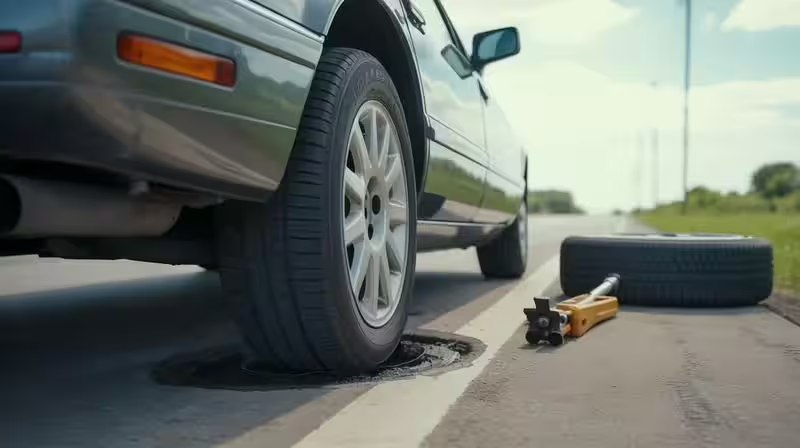
The moment you realize you have a flat tire, do not slam the brakes or make sudden steering movements. Gradually reduce speed, turn on your hazard lights, and steer toward the nearest safe spot — a parking lot, wide shoulder, or side street.
Avoid stopping on curves, narrow shoulders, or hills if possible. Your safety is more important than convenience.
Step 2: Assess the Situation
Once you are safely stopped, check the tire. Sometimes what feels like a flat is actually a slow leak that has not fully deflated. If the tire is completely flat, you have a few options:
- Use your spare tire if you have one and know how to change it
- Use a tire repair kit — many newer vehicles come with sealant and a compressor instead of a spare
- Call for roadside assistance if you are not comfortable changing the tire yourself
Step 3: Changing the Tire (If You Have a Spare)
If you are going to change it yourself, here is the process:
- Set the parking brake and place wheel wedges behind the opposite tires
- Loosen the lug nuts slightly while the tire is still on the ground (do not remove them yet)
- Position the jack under the vehicle's designated jack point (check your owner's manual)
- Raise the vehicle until the flat tire is about 15 cm off the ground
- Remove the lug nuts completely and pull off the flat tire
- Mount the spare tire and hand-tighten the lug nuts in a star pattern
- Lower the vehicle and fully tighten the lug nuts
Important: If you are using a compact spare (donut), do not drive faster than 80 km/h and get to a tire shop as soon as possible. These are temporary solutions, not long-term replacements.
Can a Flat Tire Be Repaired?
Not every flat tire needs replacement. A tire can usually be repaired if:
- The puncture is in the tread area (not the sidewall)
- The hole is smaller than 6 mm in diameter
- The tire has not been driven on while completely flat for an extended distance
- There are no other signs of structural damage
A proper tire repair involves removing the tire from the rim, inspecting the interior, and applying an internal patch-plug combination. Quick external plugs are not a permanent fix and may not be safe for highway driving.
When Replacement Is the Only Option
You will need a new tire if the puncture is in the sidewall, the hole is too large to patch safely, the tire was driven on while flat and the internal structure is damaged, or the tire tread is already near the end of its life.
Fast Flat Tire Repair in New Westminster
At Tire Point Automotive, we handle flat tire repairs every day. Bring your vehicle in and we will assess whether a repair or replacement is the right call — and get you back on the road quickly. With over 7,000 tires in stock, we can replace most tire sizes same-day.
920 Agnes Street, New Westminster. Call (604) 524-9747.
Official sources & further reading
The B.C. and federal standards referenced in this guide: